Profila Research Labs

Resolving what people want,
in conditions where
nothing is watching.

Open research on declared intent as a class of training data — and on the model it yields.

42-True Published

2026 · Apache-2.0

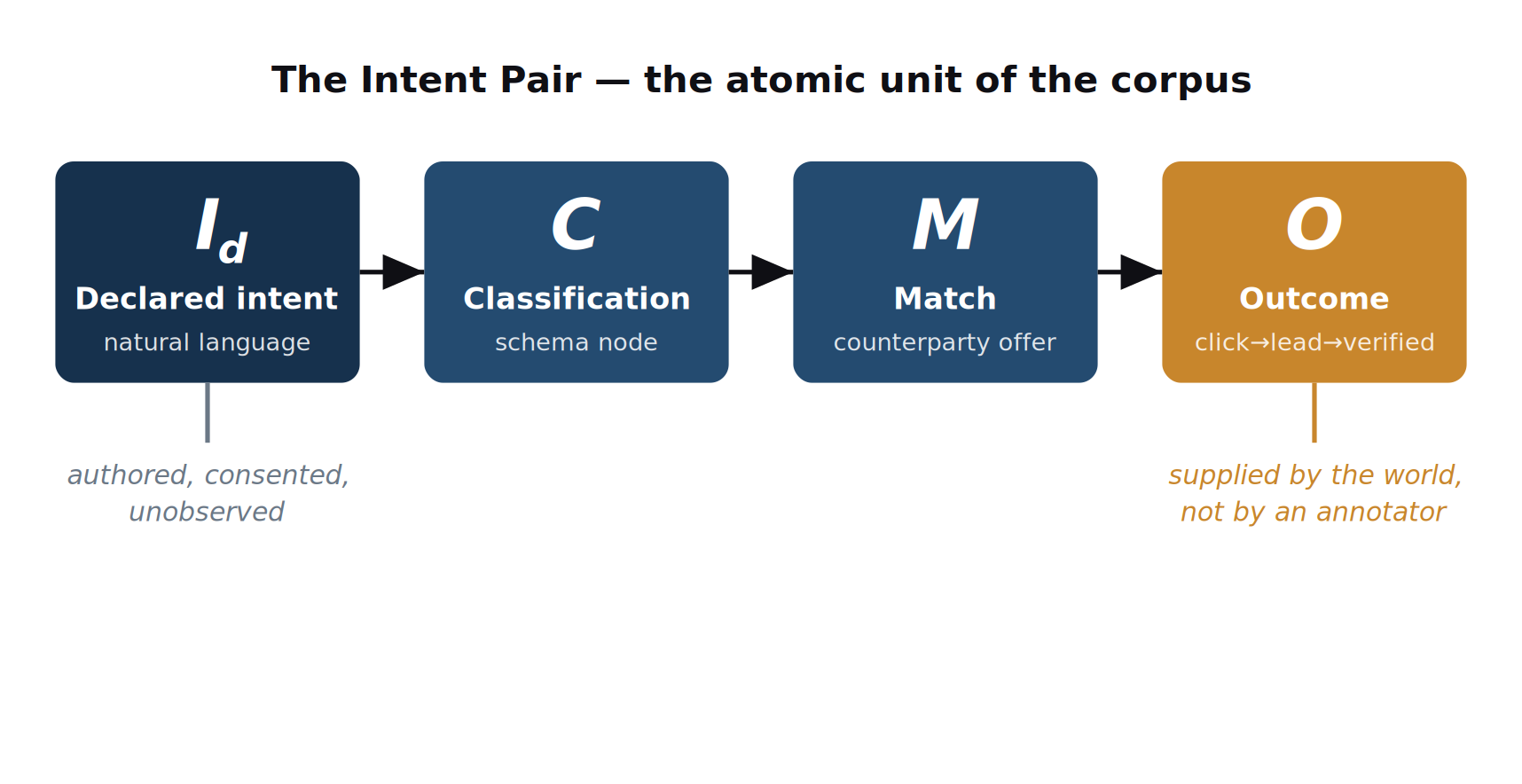
The intent pair: declared intent (Id) is classified (C), matched to a counterparty offer (M), and resolved into a lived outcome (O) supplied by the world, not by an annotator.

42-True: A Large Meaning Model for Declared Human Intent

Resolving what people want, in conditions where nothing is watching.

Contemporary AI is trained on observational data — behaviour recorded under conditions where the subject was, or assumed they were, watched. Nine decades of behavioural science establish that observation distorts behaviour. This paper proposes a complementary class of training data: declared intent paired with verified outcome, gathered where the declarant cannot be identified.

View the version of record on Zenodo
Profila Research Labs

The primitive

The intent pair is the atomic record.

The atomic unit of the corpus is the four-tuple:

IntentPair = ( Id, C, M, O )

Id — Declared intent. A want, stated in natural language, authored and consented, bound only to an unlinkable token.

C — Classification. The declaration mapped to a machine-addressable taxonomy node by a three-tier resolver (agents, community, experts).

M — Match. The counterparty offer returned in response. Counterparties see only the classification, never the raw signal.

O — Outcome. The realised consequence — graded from no-engagement through to a cryptographically verified resolution. Supplied by the declarant's own subsequent action in the world, not by an annotator.

Unlike a static NLU label (assigned by an annotator) or an RLHF preference (whose consequence is synthetic), the outcome O is lived. All records are frozen: an intent pair records what happened; corrections produce new records, and the corpus grows by accumulation.

One pair, end to end

  1. Declared “a weekend that makes me feel twenty again”
  2. Classified travel.restorative (confidence 0.91)
  3. Matched A spa-and-hiking weekend in the Alps
  4. Outcome CONVERSION, verified
Profila Research Labs

The honest part

Why this doesn't train yet.

A purely theoretical treatment of the Large Meaning Model would be shorter than this — and insufficient. The corpus does not exist. It cannot be scraped from the public web (which is observational by construction), cannot be simulated (the signal of interest is precisely what people declare when unobserved), and cannot be extracted from existing systems (whose data is the data this model is defined against).

The corpus must be produced, and production requires a network: a place where declaration is safe, a layer that classifies declarations at scale, a market that creates the conditions for outcomes to occur, and a verification layer that anchors those outcomes to attestable events. This repository is the schema and the seed; the network is the work.

Profila Research Labs

Status

Status & roadmap

0 — Concept

Schema, recipes, paper

Public

1 — Produced corpus

Declaration vault, classification tiers, attestation

Proposed

2 — Training data

Declared-intent pairs consumable by external LLM stacks

Proposed

3 — Standalone LMM

A model that resolves declared intent against the accumulated corpus

Proposed
Profila Research Labs

Stewardship

The model is the commons.

A model trained on the declared intent of a population should not be the property of any single commercial actor. The paper proposes that a foundation hold the Large Meaning Model as a commons, steward the protocol, and distribute returns to contributors in proportion to the value their contribution adds.

This is a research proposal, published in the spirit of open science. It describes what the authors argue should happen, not a corporate commitment already made.